Free Lash Extension Aftercare Card for Clients (Printable)
In this guide
Quick answer: Below is a free printable aftercare card you can give clients. A good card covers five things: the first 24 hours, the daily cleaning routine, what to avoid, when to book fills and removal, and when to see an eye doctor — plus your contact details.
Clear aftercare is the easiest way to cut "my lashes fell out" messages and to catch reactions early. This page is part of our guides for lash techs.
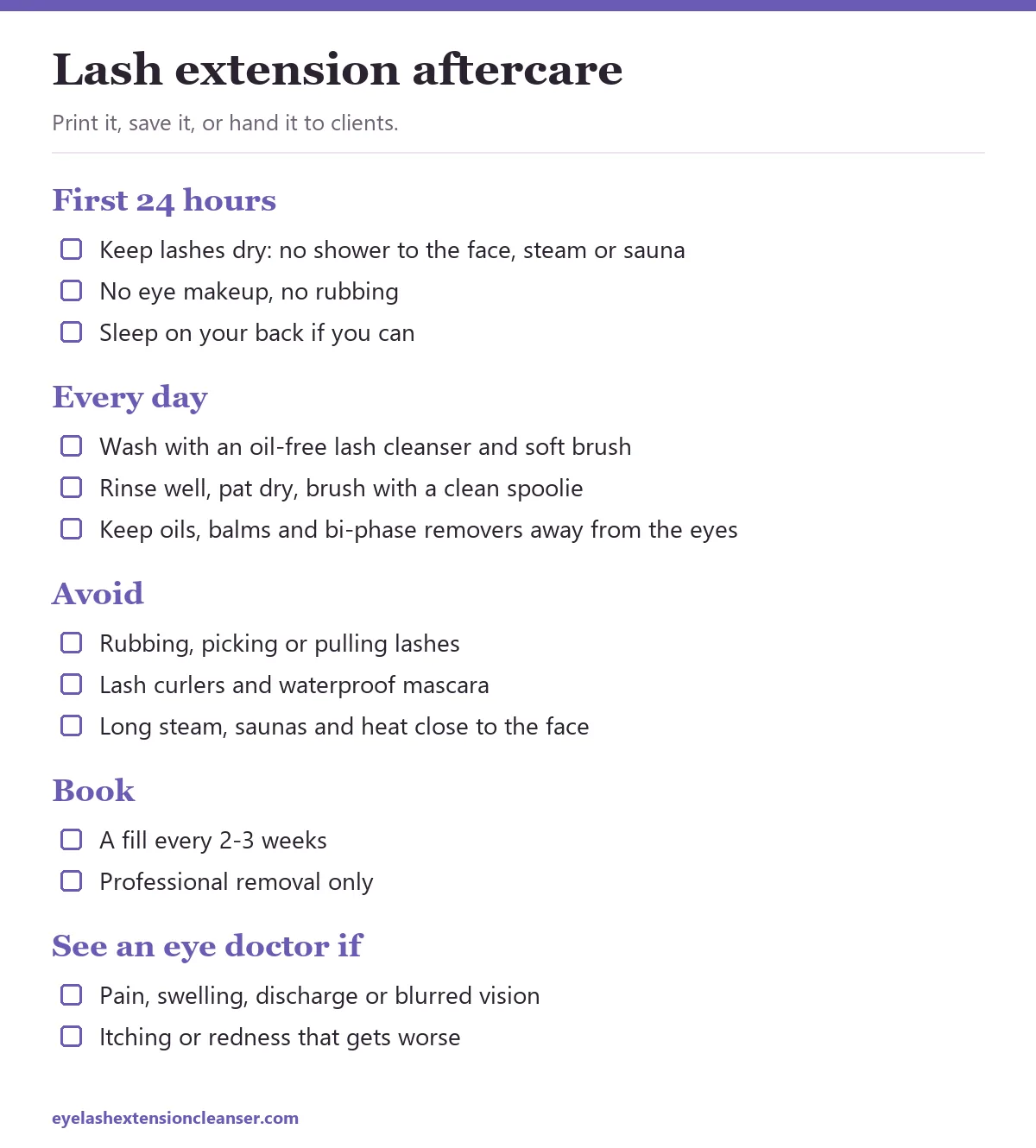
What your aftercare card should include
| Section | Key points | Why |
|---|---|---|
| First 24 hours | No water, steam or sauna; no eye makeup; no rubbing; back-sleeping | Glue may take up to six hours to solidify (EyeWiki) |
| Every day | Oil-free lash cleanser and soft brush; rinse; pat dry; brush with a clean spoolie | Keeps bonds clean (client routine) |
| Avoid | Oils, balms, bi-phase removers; rubbing; curlers; waterproof mascara; long steam | Main causes of early loss |
| Book | Fill every 2–3 weeks; professional removal only | Prevents twisting and pulling |
| See a doctor | Pain, swelling, discharge, blurred vision, itching or redness that gets worse | The AAO advises against removing extensions or treating a reaction at home (AAO) |
| Contact | Your phone, booking link, opening hours | Clients should reach you first with questions |
Wording tips
- Be specific: "Keep lashes dry for 24 hours" beats "avoid water for a while."
- Explain why, briefly: clients follow rules they understand ("oils soften the glue").
- Keep medical advice simple: list the warning signs and say "see an eye doctor" — don't suggest treatments.
- Match your products: if you retail a cleanser, name it; otherwise say "oil-free lash cleanser."
- Use your adhesive's guidance for dry time (24 or 48 hours).
How to go through it with clients
- Walk through the card at the end of the first appointment, while lashes are still fresh.
- Show the cleaning routine with a brush and foam — a 30-second demo saves questions later.
- Hand over a printed card and send a digital copy.
- Ask at each fill whether anything itched, stung or felt different; reactions can develop after previous uneventful sets.
Retail kit to pair with the card
An oil-free foam, a soft cleansing brush and a few spoolies make the card practical. See our guide to professional lash cleansers for concentrates and bulk buying, and the client-facing aftercare guide you can link to.
If clients ask what to buy, point them to our list of what goes in a lash extension aftercare kit.
If a client reacts
Have a plan before it happens: what to do when a client reacts to lash extensions. The FDA advises consumers to stop using a product that causes irritation and to see a doctor if it persists (FDA).
Key takeaways: Give every client a clear card covering the first 24 hours, daily cleaning, what to avoid, fills and removal, and warning signs. Explain it in person, send a digital copy, and use the free printable above if it helps.
Frequently asked questions
What should a lash extension aftercare card include?
The first-24-hour rules, the daily cleaning routine, what to avoid (oils, rubbing, curlers, steam), fill timing, professional removal only, and when to see an eye doctor - plus your contact details.
Can I use this aftercare card in my salon?
Yes. You're welcome to print it or share the image with clients. Linking to this page is appreciated.
Should aftercare cards say 24 or 48 hours?
Use what your adhesive manufacturer recommends. Many artists say 24 hours; some prefer 48 for volume sets or humid climates.
Should I give clients a digital or printed card?
Both work. A printed card goes home with the client; a digital copy (text or email) is easy to find again. Many salons do both.
Sources
- Eyelash Extensions (EyeWiki) — American Academy of Ophthalmology
- Eyelash Extension Facts and Safety — American Academy of Ophthalmology
- Eye Cosmetic Safety — U.S. Food and Drug Administration